Progress stays on this browser; sign in to save across devices.
What you’ll learn
Identify hazards before starting a job.
Recognize when support, tools or training are inadequate.
Use an organized stop-work and escalation process.
Document incidents and near misses without concealing conditions.
Before you start: Shop orientation. This awareness course does not replace required equipment training, employer procedures or task-specific qualification.
Read the lessons, work the examples, then check your understanding. Learning is free; assessment access is separate.
Reinforce hazard recognition, lift awareness, battery and EV precautions, housekeeping, and stop-work decisions.
What you will learn
Identify hazards before starting a job.
Recognize when support, tools or training are inadequate.
Use an organized stop-work and escalation process.
Document incidents and near misses without concealing conditions.
Before you start
Shop orientation. This awareness course does not replace required equipment training, employer procedures or task-specific qualification.
How to use this workbook
Read each lesson, work through its example, then answer the practice questions before revealing the explanations. Complete the written exercise before taking the assessment. Numerical examples are fictional training data, not vehicle service specifications.
Open study guideFree lessons for anyone. Print or save a PDF copy.
Plan for approximately 20 minutes of reading and 45 minutes working the examples and exercises. Assessment time is separate.
Course material
Study at your own pace. Open each lesson when you’re ready.
Build a pre-job hazard pictureRead & apply
Know the safety system around the task
Safe work depends on people, equipment, the vehicle and a controlled work area, not a single checklist mark.
Vehicle identification and condition
Establish the correct instructions and hazards for the actual configuration.
Lift, supports and approved accessories
Each has a defined purpose, capacity and operating procedure; appearance is not proof of compatibility.
Energy sources
Electrical, stored mechanical, hydraulic, thermal and chemical hazards can coexist.
Work zone and emergency access
Protect others and preserve routes and equipment needed for a response.
Responsible person and handoff
Make unresolved hazards and ownership visible when work changes hands.
How the parts work together
Identify the task and hazards, confirm the required controls, then reassess when conditions change. A new leak, damaged battery enclosure or removal of a heavy assembly can invalidate the original plan.
Identify and explain
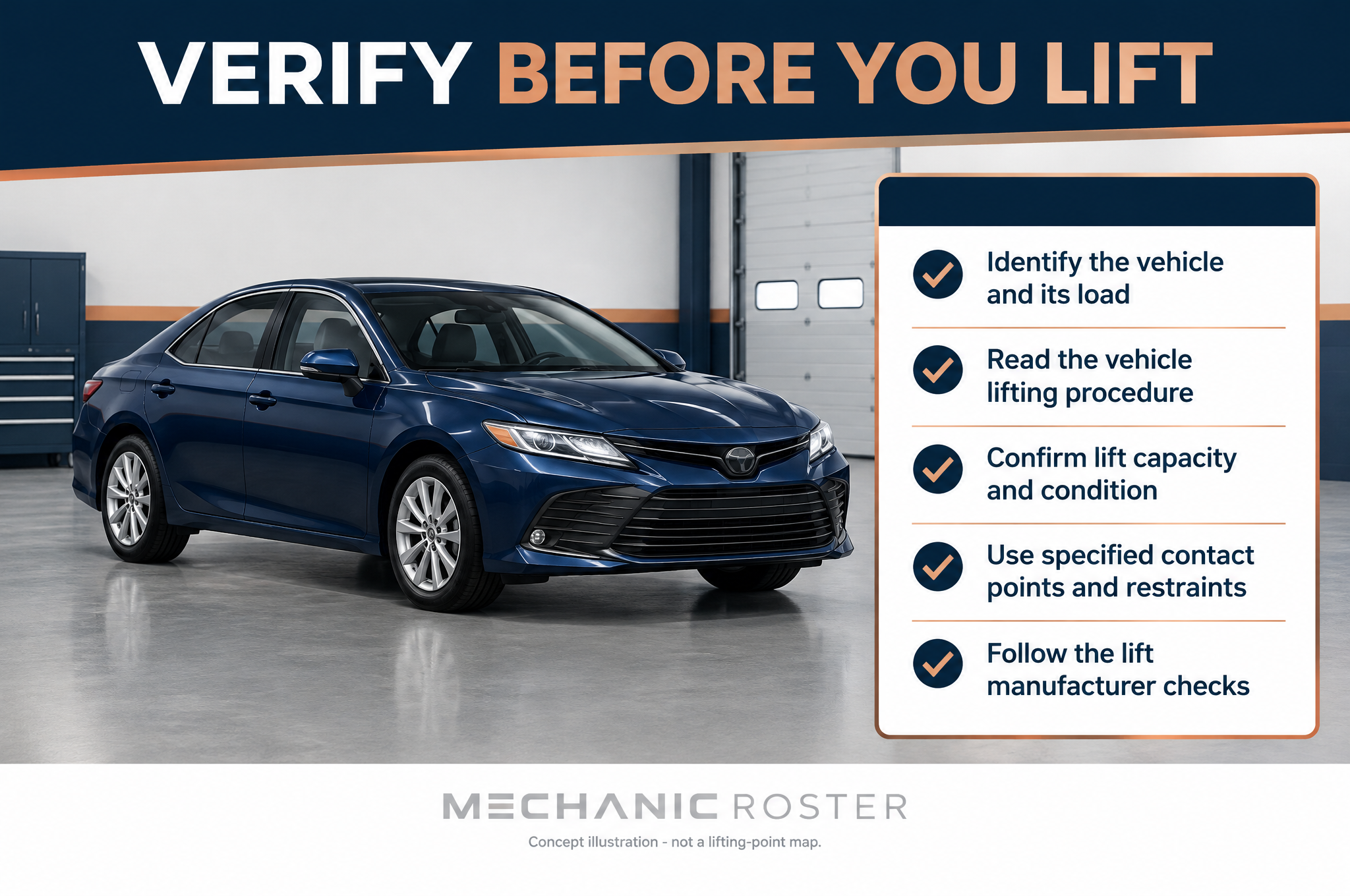
Why is a generic vehicle silhouette unsuitable as a lifting-point map?
Check your explanation
It does not identify the actual approved contact locations, configuration, adapters or balance conditions. Use the applicable vehicle and equipment instructions.
Before beginning, identify what can move, fall, become hot, release pressure, energize or contaminate the work area. Consider the vehicle as well as the task: stored spring energy, rotating parts, hot exhaust, pressurized systems, electrical energy, fluid leaks and unstable loading can be present even when the engine is off.
Review the actual service procedure, tool instructions and applicable safety data. Identify required protective equipment, ventilation, exclusion zones and disposal controls. Protective equipment is only one part of the plan; it does not make an otherwise uncontrolled hazard acceptable. If you cannot name the hazard and control, stop and obtain qualified guidance.
Look for changes from the expected condition. Collision damage, missing support points, modified wiring or an unfamiliar powertrain can make a familiar job different. Do not carry a procedure from another vehicle into this one without checking applicability. Confirm that the worker has the training and authorization required for the task.
A useful hazard review names the condition, possible consequence, control, responsible person and stop point. It should be short enough to use and specific enough to change behavior.
Identify the energy and the exposure
A useful hazard assessment names what can cause harm, how a person could be exposed and what prevents that exposure. Stored mechanical force, gravity, pressure, heat, electricity, chemicals and moving components can remain hazardous when a task appears routine. “Be careful” does not identify a control. A raised vehicle, a compressed spring and a hot cooling system need different procedures and equipment.
Separate hazard from risk judgment. The hazard is the potential source of harm; the task conditions influence the likelihood and severity of exposure. Familiarity does not remove the hazard. A job performed many times without an incident may still rely on a weak control. Before work, identify the required procedure, competent personnel, suitable equipment, workspace and stop conditions.
Choose controls in a useful order
Where appropriate, remove the exposure or use a safer method before relying only on reminders and personal protection. Engineering controls, administrative procedures and PPE have different roles. PPE must match the actual hazard and be in usable condition; a generic glove is not protection against every chemical, temperature or electrical exposure. Follow the relevant safety data and equipment instructions.
Read the job for hazards before starting
Hazard recognition starts with the actual work, not the name of the appointment. Consider vehicle movement, stored energy, hot surfaces, chemicals, rotating components, electrical sources and the surrounding work area. An engine that is off does not eliminate a compressed spring, stored pressure or an energized circuit. Identify the controls required for the task before selecting tools.
A useful pre-job discussion names the hazard, control, responsible person and condition for stopping. “Be careful” is not a control plan. If an essential procedure, qualification or suitable piece of equipment is missing, arrange the missing requirement rather than substituting confidence. This knowledge course supports recognition; it does not provide hands-on authorization for every shop task.
Pre-job safety decision
IdentifyActual task and energy sources
ControlRequired procedure, equipment and area
ConfirmQualified person and ready conditions
StopMissing or changed condition requires review
Try it before reading the answer
A suspension spring remains compressed with the engine off. What should the pre-job plan recognize?
Worked answer and reasoning
Stored mechanical energy remains. Follow the task-specific procedure with qualified personnel and suitable equipment. Engine state alone does not establish a safe condition for spring work.
Recognize safe support and equipment boundariesRead & apply
Vehicle support is a system involving the lift or stands, capacity, contact points, vehicle weight distribution, equipment condition and operator competence. Use the manufacturer-approved lifting points and the equipment instructions. A jack alone is not a safe support for work underneath a vehicle. Never improvise support with unstable objects.
Before raising, inspect equipment and contact, confirm capacity and required accessories, clear people and loose items, and follow the prescribed initial stability check. If contact shifts or stability is uncertain, stop under the equipment's safe procedure. Do not continue upward hoping the load will settle correctly.
Task changes can alter the support plan. Removing a major assembly or adding an unusual load may change balance. Reassess support before the change. Do not defeat locks, interlocks or guards to save time. Damaged equipment should be taken out of service and reported through the shop process.
Stored-energy work such as spring service requires its own procedures, suitable equipment and competence. Stop when the tool or training is missing. A second person watching does not compensate for an unsafe method.
A lifting plan has several independent checks
Lift capacity is only one consideration. The vehicle, load distribution, approved contact points, adapters, access and equipment condition also matter. An operator must be trained for the actual lift and follow its procedure. This awareness lesson is not lift-operator qualification. Current equipment instructions and appropriate supervised training determine the operational sequence.
Changes during a repair can affect stability. Removing a heavy assembly or shifting a load may alter the balance from the original lifted condition. Do not treat a vehicle that was initially stable as permanently stable through every operation. Plan the repair and any required support with qualified personnel before changing the load.
Do not normalize a defect
A damaged adapter, missing safety information or abnormal equipment behavior requires the appropriate stop, reporting and out-of-service process. A handwritten “use carefully” note is not a repair. Document the exact concern and who will resolve it. Keep the distinction between operator pre-use checks and qualified inspection/maintenance; one does not automatically replace the other.
Use the exact lifting and support instructions
Vehicle support requires the correct vehicle information and the lift or support equipment instructions. Lifting points, adapter arrangements, capacity and stability cannot be inferred from a generic silhouette. Inspect equipment as required and use the correct training for the lift. Changes in vehicle weight distribution during component removal can affect the plan.
The illustration deliberately does not mark universal lifting points. Its purpose is to remind the learner to identify the source of the correct points and conditions. A jack used for lifting is not sufficient standalone support for work beneath the vehicle. If the support arrangement is uncertain, do not enter the hazard area while someone improvises a solution.
A silhouette cannot authorize a lifting point Pre-lift planning reminder only. No approved lifting points, adapter positions or safe support setup are depicted. Use the vehicle-specific procedure for service.
Try it before reading the answer
A technician remembers the lift points from a similar model. What should happen before lifting this vehicle?
Worked answer and reasoning
Verify the exact vehicle's applicable lifting information and the equipment setup requirements. Similar appearance or memory from another model does not establish the correct points or arrangement.
Control exposure, housekeeping and energyRead & apply
Keep walkways, exits and work zones clear. Route leads and hoses to reduce trip and snag hazards. Identify fluid spills, isolate the area and use the approved cleanup method and protective equipment. Do not wash unknown chemicals into a drain or mix products based on appearance. Follow safety data and disposal requirements.
Brake and clutch dust needs approved exposure controls. Do not disperse exposed dust with compressed air or uncontrolled dry sweeping. Use the shop's applicable compliant cleaning method and required protection. A product that looks clean is not proof that it contains no hazardous material.
Before working near moving parts, hot components or stored pressure, use the prescribed controls. Ignition-off status alone does not eliminate all energy. Batteries, capacitors, springs, pressurized systems and automatic actuators may retain or release energy. Follow the task-specific isolation procedure and verification requirements through qualified personnel.
When smoke, unusual heat or other emergency signs are present, prioritize people and follow the site emergency response plan. Do not improvise battery handling or try to complete a routine inspection before escalating.
Control the work area, not just the person
Keep walking routes and exits clear, manage hoses and cords, and prevent contamination of working and friction surfaces. A spill needs identification, suitable containment and cleanup, and correct disposal under the relevant procedure. Do not wash an unknown fluid into a drain or combine waste streams because containers look similar.
Use the safety data sheet and product instructions to identify exposure controls and response information. Labels must remain understandable. An unmarked bottle creates uncertainty about compatible use, storage and response. Ventilation and local controls may be required for a process; opening a door is not automatically an adequate substitute.
Think about bystanders
Dust, sparks, noise and moving equipment can affect people beyond the person doing the task. Define the work zone and prevent unauthorized entry where necessary. Control brake/clutch dust through approved methods rather than dispersing it with compressed air. Select the method before starting, not after the first exposure occurs. Preserve a clean handoff so the next shift does not inherit an unidentified hazard.
Control exposure and changing conditions
Housekeeping, chemical handling and protective equipment are part of the task, not cosmetic finishing steps. Identify the substance and applicable safety information before selecting controls. Protect against slips, inappropriate contact and exposure using the shop's approved procedure. Do not mix unknown products or improvise a cleanup method from appearance alone.
Conditions can change during work. A new leak, damaged cable, unstable support or unexpected heat requires reassessment. Record the new condition and communicate it to the responsible person. A previously approved plan is not blanket permission to continue after its assumptions no longer hold.
Recognition exercise—not a substitute for procedures
Changed condition
Required decision
Unexpected chemical leak
Identify substance and follow response process
Support uncertainty
Stop and obtain qualified verification
Damaged electrical cable
Control access and refer to qualified personnel
Blocked exit
Restore the required safe access
Try it before reading the answer
Why is continuing under the original plan inappropriate after an unexpected hazard appears?
Worked answer and reasoning
The original plan depended on conditions that have changed. Stop the affected work, control the area as trained and obtain the appropriate reassessment before resuming.
Stop work when a hazard is uncontrolled, the condition differs materially from the plan, required equipment is unavailable or the worker lacks qualification. State the problem clearly and secure the area only within your training and without adding exposure. Notify the responsible lead and follow the established emergency or incident procedure where needed.
A stop-work message should identify the job, observed hazard, current controls and what is needed before resumption. “Unsafe” without detail may not help the next person. “Lift contact shifted during the prescribed initial check; operation stopped and area controlled; supervisor review needed” is actionable.
Record incidents and near misses promptly. Include observed facts, time, location, equipment, people involved as appropriate under policy, actions taken and follow-up owner. Avoid speculation or blame. A near miss can reveal a failed control even when nobody was injured. Do not erase it because the outcome happened to be harmless.
Managers should review patterns and close corrective actions. A completed training certificate supports knowledge development, but it does not replace supervision, equipment inspections or the employer's safety system.
Make stop-work actionable
A good stop-work report identifies the task, observed hazard, immediate safe state, affected area, person notified and requirement for resumption. It does not need a confident diagnosis of the equipment fault to justify pausing an unsafe operation. Schedule pressure and customer urgency do not supply missing training, equipment or information.
For an incident or near miss, follow the site's response process, obtain appropriate assistance and preserve relevant facts. Separate observations from assumptions. A near miss is useful evidence about a control that failed or nearly failed, even if nobody was injured. Do not edit the record to make a target look better or assign blame before understanding the event.
Return to work only when the gap is closed
Resumption needs the required corrective action and authorization under the applicable process. Confirm who checked the equipment or condition and what changed. “The manager knows” is not evidence that a hazard was resolved. A professional handoff explains the safe operating boundary and any remaining restriction to everyone affected.
Make stop-work and handoff actionable
A stop-work report should state the observed condition, location, time, immediate controls and who was notified. Keep facts separate from guesses about cause. “Support shifted during the specified check; area restricted; supervisor notified” gives the next person something to act on. Blame without evidence distracts from establishing the next safe action.
Before work resumes, the responsible qualified person must establish that the required conditions and controls are in place. A new shift or a quieter symptom does not automatically clear the concern. Transfer status explicitly, including what remains unknown and who owns the next decision. Review incidents and near misses for process improvements rather than merely assigning fault.
Stop-work handoff
ObserveState facts, location and time
ControlUse the response actions within your training
NotifyObtain an accountable decision owner
ResumeOnly after required conditions are established
Try it before reading the answer
A notification was sent but no responsible person has accepted the issue. Is the handoff complete?
Worked answer and reasoning
No. Maintain the appropriate controls and follow the escalation process until responsibility and the next action are clear. Sending a message is not itself verification that work can resume.
Case conference: the lift plan is no longer valid
A vehicle is prepared for lifting, but the technician cannot verify the approved contact points for this configuration. An adapter is nearby, yet its suitability has not been established. The appointment is already running late.
Case evidence — read before choosing an action
Decision gate
Evidence required
If missing
Vehicle and task
Correct configuration and planned work
Clarify before proceeding
Lift and accessories
Capacity, condition and approved compatibility
Remove uncertainty; do not improvise
Contact and balance
Applicable vehicle/lift instructions
Stop and obtain the correct information
Change during work
Reassessment under the procedure
Do not assume the original setup remains valid
Work through the decision
A familiar-looking underbody location is not proof of an approved lifting point. Use the specific vehicle and lift instructions and the shop's trained operating procedure. Equipment capacity alone does not establish safe positioning or adapter compatibility. If the required information cannot be confirmed, the proper action is to stop, not to invent a contact point from a generic picture.
Before operation, confirm equipment condition, the work area and any vehicle condition that changes the plan. Follow the prescribed contact, stability and locking checks in the equipment instructions. Removal of heavy assemblies can change balance; this requires a planned reassessment and approved support method, not an assumption that the initial setup remains safe.
A useful stop-work report identifies the uncertainty, protects the area and names who will resolve it. Production pressure does not substitute for evidence. If you receive a vehicle already positioned by someone else, establish its documented status rather than treating another person's presence as confirmation that every check was completed.
Your decision and evidence
Write the stop-work note and list the information needed before the lift plan can be resumed.
Model answer and reasoning
'Lift operation paused: approved contact points and adapter compatibility not verified for this configuration. Vehicle status and access controlled under site procedure; supervisor notified.' Obtain the exact vehicle/lift instructions, appropriate accessories and qualified review. Do not resume based on a generic illustration or schedule pressure.
Check your work
Rejects guessed contact points
Includes equipment and vehicle-specific instructions
Write your decision before revealing the model answer. These scenarios and numbers are fictional training examples.
Capacity is correct but the setup is not
A lift's rated capacity exceeds the vehicle weight. However, an adapter is damaged and the operator cannot identify the approved contact points. The customer is waiting, and a coworker says the same setup worked yesterday.
Identify why the capacity comparison is insufficient. Write a stop-work note and the conditions that must be met before the job resumes.
Your evidence, decision and next step:
Compare with the model answer
Capacity does not validate damaged contact equipment, unknown support points or operator readiness. Stop the lifting operation and follow the equipment/shop process for the defect. Obtain the correct vehicle contact information, suitable serviceable equipment and a trained operator. The record should name the damaged adapter and information gap, who was notified and the required resolution. Yesterday's outcome is not evidence that today's setup is safe. Only the appropriate qualified process can clear the identified conditions.
A near miss at shift change
A technician nearly slips on an unidentified fluid beside a hose crossing the aisle. No injury occurs. The next shift is arriving, and someone suggests leaving a small sign and recording nothing because the safety report would look worse.
State the immediate control priorities, the facts to record and a process improvement that addresses more than individual attention.
Your evidence, decision and next step:
Compare with the model answer
Control access to the area, identify the substance and use the appropriate cleanup and disposal procedure. Correct the hose-routing hazard and communicate the remaining boundary during handoff. Record the location, observed conditions, time, people notified and action taken without guessing the fluid's source. Review why inspection, routing or handoff controls missed it. A defined end-of-shift area check and clear ownership can improve the process. Suppressing a near miss removes information needed to prevent a future injury.
Apply it to a job
Build a hazard review for a fictional brake inspection: hazard, consequence, control and stop point. Write a lift-instability stop-work message and a near-miss report using observed facts. Identify which actions require equipment training and which high-voltage actions remain outside this course. Practice a handoff without operating equipment.
Your evidence and decision
Concern / scenario:
Observation, measurement and reference:
Interpretation and next action:
What remains unknown / who needs to review:
Verification and handoff:
Check your understanding
Explain each item in your own words. Revisit the relevant lesson if you cannot. This self-review is not a practical-skills sign-off.
Name an energy source, exposure path and suitable control.
Explain why lift capacity alone does not establish a safe setup.
Use safety information rather than generic PPE assumptions.
Write a useful stop-work and shift-handoff record.
Investigate a near miss as a process-learning event.
Practice before the assessment
Free, ungraded practice. Choose an answer, then check the explanation. These are separate from the final assessment bank.
Further study
Use current vehicle and equipment information for actual service. These public resources informed subject scope and support further learning; Mechanic Roster lessons and questions are original.