Verify fitment and application, compare tire choices transparently, explain maintenance, and recommend products without pressure.
What you will learn
Check fitment before recommending a tire.
Connect customer use to compatible choices.
Explain a complete installed price and documented tradeoffs.
Record the selected option and required delivery checks.
Before you start
Basic tire identification. Mounting, inflation and wheel service require suitable equipment and supervised training.
How to use this workbook
Read each lesson, work through its example, then answer the practice questions before revealing the explanations. Complete the written exercise before taking the assessment. Numerical examples are fictional training data, not vehicle service specifications.
Open study guideFree lessons for anyone. Print or save a PDF copy.
Plan for approximately 20 minutes of reading and 45 minutes working the examples and exercises. Assessment time is separate.
Course material
Study at your own pace. Open each lesson when you’re ready.
Establish fitment before priceRead & apply
Know the specification before comparing products
The anatomy of a tire recommendation includes compatibility, operating requirements and the complete offered scope.
Size designation
Describes dimensional information; matching only one dimension is insufficient.
Load and speed descriptions
Must be evaluated against applicable vehicle requirements, not selected by price alone.
Wheel compatibility
Wheel dimensions, condition and approved tire fitment matter together.
Vehicle-specific matching requirements
Replacement arrangements and circumference tolerances can depend on the drivetrain and manufacturer.
Package scope
Tires, installation services, applicable fees and conditions must be visible in a fair comparison.
How the parts work together
Screen suitability first. Then compare documented product characteristics against actual use and budget. A more expensive package is not automatically the right fit, and a familiar size does not establish complete compatibility.
Identify and explain
What should be settled before presenting two tires as alternatives?
Check your explanation
Applicable size, ratings, wheel compatibility and vehicle-specific restrictions must be checked. Only suitable options should proceed to a scope-equivalent comparison.
Start with vehicle identity, the tire placard, current approved fitment information and what is actually installed. A tire that physically fits a wheel is not necessarily suitable for the vehicle. Confirm size, load capacity, speed category, wheel compatibility, axle configuration and any special requirements. Staggered front/rear sizes, run-flat systems, directional or asymmetric patterns and TPMS can affect the proposed service.
Read markings as a system rather than choosing by appearance. In a size such as 225/55R17, the numbers describe nominal section width, aspect ratio and rim diameter; they do not alone establish load capacity or approval for a specific vehicle. The service description adds load index and speed symbol. Use manufacturer tables and the approved application guidance rather than guessing from a higher-looking number.
Check whether the vehicle or tire manufacturer requires particular matching, circumference or replacement practices, especially on certain all-wheel-drive applications. Do not invent one tread-depth difference for all drivetrains. Record current sizes and conditions at each position before recommending how many tires to replace.
A tire's sidewall pressure marking is not automatically the vehicle's recommended operating pressure. Use the applicable vehicle placard and approved fitment guidance. Explain any nonstandard application through the proper manufacturer information.
Build a compatibility gate before a sales comparison
Confirm the vehicle, approved tire/wheel configuration, relevant load and speed requirements, use conditions and manufacturer restrictions. Load index is a code associated with load capability under specified conditions; it is not the tire's recommended inflation pressure. Speed rating describes a rated capability under defined conditions, not permission to drive at that speed. A physically mountable tire is not automatically an appropriate replacement.
Identify staggered fitment, directional requirements, drivetrain matching guidance and any other application-specific constraints. A same-size tire with a different service description may fail the compatibility gate. Use the applicable manufacturer data instead of choosing by inventory availability or the largest advertised number alone.
Document the basis
Record the selected specification source and the candidate product's relevant markings. If an alternative size or configuration is proposed, obtain the proper fitment and load/inflation guidance before presenting it as equivalent. Do not ask the customer to select among options that have not yet been established as suitable. Compatibility is a prerequisite, not an optional premium feature.
Establish compatibility before presenting options
A sales conversation begins with the vehicle and application requirements, not the product with the highest margin. Verify the required size and position-specific fitment, relevant ratings and any restrictions from vehicle and tire information. The existing tire may be wrong for the vehicle, so copying its sidewall is not a complete fitment check. A staggered arrangement requires separate attention to each axle or position.
Ask how the customer uses the vehicle and which priorities matter: ride comfort, operating conditions, towing or load use, budget and expected service. Those preferences help compare compatible choices; they do not override the required fitment. If a proposed alternative requires additional technical confirmation, say so before quoting it as an approved substitute.
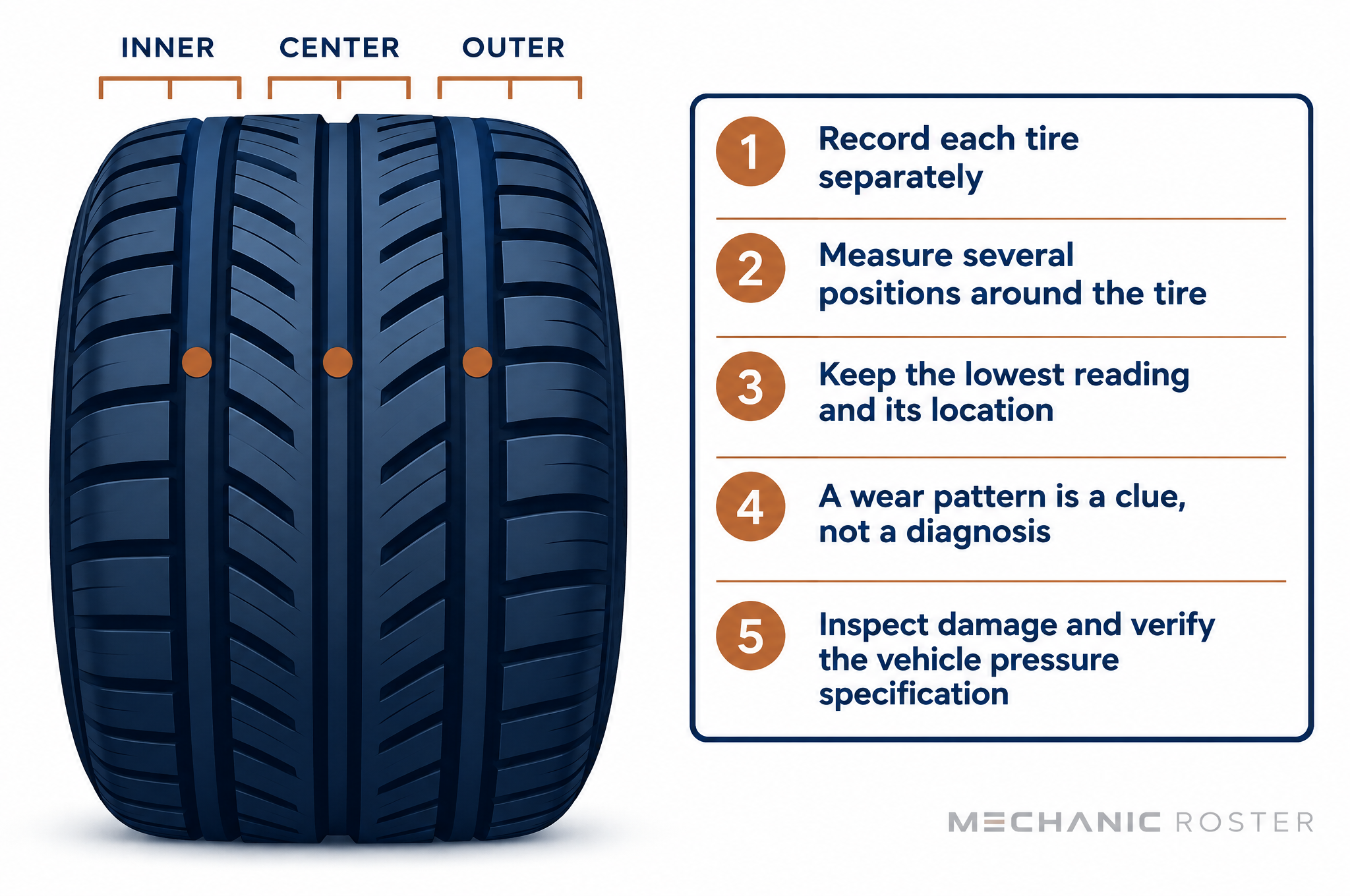
Compatibility comes before preference Inner and outer refer to the installed vehicle orientation, not a universal left/right side of this picture. Marked regions illustrate inspection coverage, not exact gauge-placement instructions. Use the vehicle-specific procedure for service.
Try it before reading the answer
A less expensive tire has the same nominal size but a different relevant rating. Is equal size enough to approve the substitution?
Worked answer and reasoning
No. Verify all applicable requirements and permitted substitutions using the relevant vehicle and tire information. Price and one matching size field do not establish full compatibility.
Discover needs and compare compatible optionsRead & apply
Ask about climate, annual mileage, highway versus local use, wet-weather concerns, noise, comfort, towing or loading and budget. The purpose is to find a suitable choice, not steer everyone to the highest margin. Confirm that the person understands how different priorities can involve tradeoffs.
Compare only compatible products. Use documented information for warranty terms, intended application, availability and relevant performance claims. Do not present a treadwear number or marketing phrase as a precise promise of miles on this particular vehicle. Maintenance, use and warranty conditions matter. A higher price alone does not prove every performance attribute is better.
Offer a small, understandable set of choices. For each, explain why it fits the customer's needs, the meaningful tradeoff, the total installed cost and timing. If a requested option does not meet the application requirements, explain the specific incompatibility rather than dismissing the customer's budget.
Do not manufacture urgency. If the inspection found damage or insufficient tread under the applicable guidance, show that actual evidence. If replacement is optional or a future plan, say so. Honest priorities build repeat business better than fear-based language.
Discover the customer's actual trade-offs
Ask about typical distance, road conditions, climate, load, comfort preferences, noise sensitivity and budget. Distinguish occasional use from routine demands. Avoid leading questions that merely steer toward the highest-margin product. Summarize the customer's priorities and confirm you understood before comparing options.
Compare only compatible products using relevant, supportable attributes. Separate manufacturer claims, warranty terms and your shop's experience. Do not promise a specific mileage outcome or wet-road performance that the evidence does not establish. A treadwear warranty has conditions; it is not the same as a guarantee that every driver will receive that distance.
A useful comparison sentence
“Both options meet the required fitment. This option is priced lower; this one has these documented warranty terms and features relevant to the priorities you described.” Explain the actual difference and any uncertainty. “Good, better, best” labels without criteria encourage decisions based on hierarchy rather than fit. Give the customer room to ask questions or decline.
Compare choices using the same scope
When comparing compatible products, keep the service scope and stated assumptions consistent. Explain what each option changes and what remains the same. A warranty mileage statement is not a promise of actual service life under every use. Review applicable conditions and exclusions rather than presenting a headline number as guaranteed mileage.
Use a short comparison record with the customer's priorities and the reason for the recommendation. Avoid exaggerated claims such as “this tire will eliminate every noise.” A useful explanation connects a product characteristic to a customer need and identifies tradeoffs. If the customer chooses a different compatible option, document the decision without implying the choice waives unrelated safety requirements.
Consultative recommendation
NeedClarify use, priorities and budget
CompatibilityVerify required fitment and ratings
CompareExplain relevant tradeoffs and terms
DecisionRecord the chosen scope without pressure
Try it before reading the answer
Write a response to “Does the mileage warranty mean these will definitely last that long?”
Worked answer and reasoning
Explain that the warranty has specific conditions and limits and is not a guarantee of actual lifespan. Review the applicable terms and relevant maintenance expectations for the chosen tire rather than promising a fixed outcome.
State the exact product, size, service description, quantity and position or axle plan. Separate tire price, mounting, balancing, valve or TPMS service, applicable disposal or environmental charges, taxes and other authorized items. Include any required related work. A quote for tires alone should not be described as a complete installed price.
Explain what the warranty includes, its conditions and exclusions, and how service records are maintained. Do not imply that a treadwear warranty guarantees free replacement for any damage. Road-hazard products, if offered, are separate choices with their own terms; do not silently add them.
Recommend alignment when inspection findings, symptoms or measurements support it, and explain the scope. New tires do not automatically prove that geometry is wrong; equally, new tires do not repair an existing wear cause. Balance, alignment and tire replacement address different concerns and should not be described as interchangeable.
Record the customer's selected option, understood tradeoffs, agreed scope, amount and timing. If availability changes and a different product is proposed, revisit that decision rather than substituting silently.
Make the installed total visible
A complete proposal identifies quantity, exact product, unit price, mounting/balancing, applicable valve or monitoring-system service, disposal, taxes and any other disclosed charges. Distinguish required associated work from optional recommendations. A low per-tire headline can mislead if the customer only learns the installed total at pickup.
For a fictional quote, four tires at $150 total $600; mounting/balancing at $25 each adds $100; disclosed disposal at $4 each adds $16. The pre-tax subtotal is $716 before any separately stated authorized item. If a second offer includes those services in its tire price, compare the installed totals and scope, not only the tire line.
Handle a budget objection ethically
Clarify which constraint matters. Offer a suitable lower-priced option, a legitimate timing choice or a revised scope that remains appropriate. Do not quietly substitute an incompatible rating or remove required service to reach the customer's number. Record the exact product and scope approved so the installed set matches the decision.
Quote the complete package transparently
A fair comparison states the full proposed scope. In the fictional worksheet, four tires at $145 cost $580. Four installation services at $25 add $100, and disposal at $4 each adds $16, for a $696 subtotal before any separately disclosed applicable charges. Omitting one category makes a seemingly lower quote difficult to compare.
Distinguish included work, separately recommended work and optional choices. New tires alone do not prove an alignment is out of specification; an alignment recommendation should explain its evidence or purpose. Do not imply a balance procedure adjusts geometry. If an added service is needed, describe its scope and cost and obtain the required decision before performing it.
Fictional tire proposal—before other applicable charges
Item
Calculation
Amount
Four tires
4 × $145
$580
Installation
4 × $25
$100
Disposal
4 × $4
$16
Subtotal
580 + 100 + 16
$696
Try it before reading the answer
A second compatible option costs $160 per tire with the same other items. Calculate its subtotal and difference from the first.
Worked answer and reasoning
Four tires cost $640; adding $100 and $16 gives $756. The difference is $60. Keep any other applicable charges and warranty differences explicit so the comparison does not imply that subtotal alone captures every term.
Deliver the service and maintenance planRead & apply
The advisor's job does not end at the sale. Confirm that the installed product and quantity match the approved proposal. Required wheel, tire and TPMS work must follow the actual equipment and vehicle procedures, including wheel-fastener requirements, pressure, orientation and any sensor programming or relearn. This course does not provide a universal torque value or authorize unsupervised tire-machine use.
Record pressure and the reference used. Check relevant TPMS function and warning status under the procedure. A warning system is not a substitute for routine pressure and condition checks. Explain cold-pressure checks, applicable rotation guidance, inspection for damage and wear, and where to find vehicle and tire instructions. Rotation patterns vary with fitment and design.
Provide warranty documents and maintenance-record requirements. If there is a follow-up inspection or recheck required by the applicable procedure, communicate the actual instruction without inventing a universal interval. Distinguish an unresolved vibration or alignment concern from completed tire installation.
Use the completed job to check your recommendation process: Was fitment verified first? Were claims documented? Did the customer choose knowingly? Were required services included and verified? Those questions measure quality more usefully than sales volume alone.
Deliver what was sold and verify it
Before handoff, compare the installed products and positions with the approved specification and invoice. Follow the applicable pressure, mounting, balancing, fastener and monitoring-system procedures through qualified personnel. Complete required relearn or other checks and retain the result. An invoice description alone does not prove the correct products were installed.
Explain the applicable pressure-check, rotation and inspection guidance for the actual configuration. A directional or staggered setup may change the permitted rotation pattern. Explain warranty conditions accurately and provide the relevant documents. Do not promise that new tires will correct an uninvestigated vibration, pull or suspension concern.
Follow up without pressure
Invite the customer to report concerns and define the contact path. If a concern returns, inspect the evidence rather than assuming misuse or treating the sale as proof of a successful service. Good consultative selling continues through delivery and support; the objective is an appropriate purchase understood by the customer, not merely a completed transaction.
Deliver a maintenance plan the customer can use
At delivery, confirm the installed product and position-specific arrangement match the approved scope. Explain the applicable pressure reference, monitoring-system requirements and maintenance guidance. Do not give a universal rotation pattern when fitment or vehicle information restricts it. Record relevant checks rather than using an invoice product line as proof of correct installation.
Invite questions about noise, vibration or warning indications without promising that all such concerns are normal. If a new concern appears, arrange an evidence-based check. A useful sales outcome is a compatible product, an informed decision and a clear service record—not merely acceptance of the most expensive quote.
Complete the sale responsibly
MatchInstalled items match the approval
CheckRequired fitment, assembly and system steps
ExplainApplicable maintenance and warranty terms
Follow throughGive a clear route for questions or concerns
Try it before reading the answer
A customer assumes the tire purchase includes alignment and balancing as the same service. How should the advisor clarify it?
Worked answer and reasoning
Explain that balancing addresses rotating mass distribution while alignment concerns wheel geometry. Identify which services are included in this quote, the basis for any additional recommendation and the separate decision required.
Case conference: explain a tire package without hiding the scope
Two fictional packages have already been screened for the vehicle's required fitment and ratings. The customer values wet-weather performance and total cost. Published product information, applicable vehicle requirements and the customer's usage should guide comparison; this exercise supplies no performance ranking.
Case evidence — read before choosing an action
Quoted item
Package A
Package B
Four tires
$480
$560
Installation/services
$100
$100
Listed other fees
$20
$20
Subtotal before applicable tax
$600
$680
Difference on the same scope
$80
$20 per tire equivalent
Work through the decision
Compare complete packages on the same scope. A low headline tire price is not a fair comparison if necessary services or fees are omitted. Here the difference is $80 before applicable tax, not an unexplained monthly payment or a claim that one tire is inherently safer. Describe what installation includes and whether any additional work is conditional.
Suitability comes before price. Verify size, load and speed requirements, wheel compatibility, vehicle-specific matching requirements and any restrictions relevant to the vehicle. Do not infer that matching diameter alone establishes compatibility. All-wheel-drive matching limits and replacement arrangements must come from applicable guidance, not a universal rule invented for the sale.
Connect product information to the customer's priorities honestly. Discuss documented trade-offs, warranty terms and maintenance responsibilities without promising a mileage outcome or a result unsupported by the manufacturer. Confirm the final choice, scope and price basis, then provide the appropriate pressure and maintenance handoff.
Your decision and evidence
Explain the $80 difference neutrally and name two checks that must happen before either package is offered as suitable.
Model answer and reasoning
Both figures include the same listed services and fees; B costs $80 more before applicable tax. Compare documented attributes relevant to the customer rather than inventing a ranking. Verify vehicle fitment/ratings and vehicle-specific matching requirements, along with wheel compatibility and restrictions.
Write your decision before revealing the model answer. These scenarios and numbers are fictional training examples.
The lowest price is not a compatible option
A customer wants the cheapest four tires. The lowest-priced stock item matches the nominal size but not the required load description. A second option meets the verified requirements and costs more. The advisor proposes the first because the customer “accepted the risk.”
Explain why this is not a valid comparison and role-play a response that respects the budget without presenting an unsuitable fitment as equivalent.
Your evidence, decision and next step:
Compare with the model answer
The first product has not passed the compatibility gate. A price preference does not establish suitability or replace the applicable requirements. Explain the specific mismatch in plain language, then compare appropriate alternatives, availability and installed totals. If no suitable option fits the current budget, say so without pressure or a fabricated promise. Record the approved product and scope. The goal is an informed decision among suitable options, not a signature used to justify a known mismatch.
Compare two installed offers
Offer A lists four tires at $150, mounting/balancing at $25 each and disposal at $4 each. Offer B is $180 per tire with those services included. Both are compatible and have the same tax treatment for this exercise. A salesperson claims A saves $120 by comparing tire prices alone.
Calculate the pre-tax installed totals and the actual difference. List the non-price information a customer still needs before choosing.
Your evidence, decision and next step:
Compare with the model answer
A totals $600+$100+$16 = $716. B totals $720. The difference is $4, not $120. Compare exact products, documented performance attributes relevant to the customer's needs, warranty conditions, included service scope and availability. If monitoring-system service or another item is not included, disclose it consistently in both comparisons. Do not create a false savings claim by omitting charges from one side.
Apply it to a job
Create a fictional customer-use profile and compare two compatible tire options without brand claims you cannot verify. Build an itemized four-tire quote using the exercise amounts. Record an approved selection and a declined optional plan. Write a delivery checklist covering product match, pressure reference, wheel procedure, TPMS and warranty handoff.
Your evidence and decision
Concern / scenario:
Observation, measurement and reference:
Interpretation and next action:
What remains unknown / who needs to review:
Verification and handoff:
Check your understanding
Explain each item in your own words. Revisit the relevant lesson if you cannot. This self-review is not a practical-skills sign-off.
Apply fitment requirements before comparing price.
Distinguish load index, speed rating and pressure guidance.
Discover customer needs without steering by pressure.
Calculate and explain a complete installed total.
Verify the installed product and provide accurate maintenance/warranty guidance.
Practice before the assessment
Free, ungraded practice. Choose an answer, then check the explanation. These are separate from the final assessment bank.
Further study
Use current vehicle and equipment information for actual service. These public resources informed subject scope and support further learning; Mechanic Roster lessons and questions are original.