Read each lesson, work through its example, then answer the practice questions before revealing the explanations. Complete the written exercise before taking the assessment. Numerical examples are fictional training data, not vehicle service specifications.
Open study guideFree lessons for anyone. Print or save a PDF copy.
Plan for approximately 20 minutes of reading and 45 minutes working the examples and exercises. Assessment time is separate.
Course material
Study at your own pace. Open each lesson when you’re ready.
Identify each tire and inspect before serviceRead & apply
Know the components: tire, wheel and pressure monitoring
Separate the physical air-retention system from the electronic or inferred pressure-monitoring system.
Tread, shoulders and sidewalls
Different tire regions require inspection; record location rather than describing the whole tire as one reading.
Bead and wheel seating area
Form part of the tire-to-wheel interface. Damage and contamination require the appropriate inspection.
Valve assembly
Provides inflation access and can be a leak location; direct sensors may be integrated with particular valve arrangements.
Direct TPMS sensor
Measures pressure at a wheel using an equipped sensor; procedures depend on system design.
Indirect TPMS
Infers relevant changes from vehicle signals rather than using a pressure sensor in every wheel.
Vehicle placard
Provides vehicle-specific tire information; the sidewall maximum is not the routine inflation target.
How the parts work together
The tire, wheel and valve retain air. A monitoring system observes pressure or related behavior; it does not prevent a leak. Diagnose physical pressure loss and system faults separately before deciding whether sensor work is needed.
Identify and explain
Can a functioning pressure sensor coexist with a leaking tire?
Check your explanation
Yes. Detecting or reporting low pressure does not establish that the sensor caused the loss. Inspect the physical system and use the applicable electronic procedure.
Record vehicle identity and the approved fitment, then inspect what is installed at each position. Note size, relevant ratings, visible damage, wear and any special directional, asymmetric, run-flat or staggered requirements. A single tire's condition does not represent all four, and a spare may have different operating instructions.
Inspect accessible tread, sidewalls, bead-area concerns and wheel condition using the approved safe method. Cuts, bulges, exposed reinforcement or evidence of severe damage require appropriate evaluation; do not describe a visibly damaged tire as safe merely because it holds air. Likewise, a puncture's repairability cannot be judged only from the outside without the required inspection and manufacturer criteria.
Record tire identification and age-related information where relevant under the applicable guidance, but do not invent one universal replacement age for every product and use. Condition, history, manufacturer recommendations and application all matter. Ask about impacts, underinflation, previous repairs and recurring pressure loss.
Keep the vehicle safe for inspection. Tire mounting, demounting and inflation can involve serious hazards and belong with trained personnel, appropriate equipment and exact procedures.
Read the installed configuration before judging it
Record size, service description and position for every tire, including relevant spare information. A size marking and a load/speed description answer different questions. Matching nominal size alone does not establish full suitability for the vehicle, wheel or use. Staggered, directional and other application-specific arrangements can affect rotation and replacement decisions.
Inspect the accessible tread, sidewall, bead-area context and wheel condition through the appropriate method. Cuts, bulges, exposed material, abnormal wear and signs of operation while underinflated need specific evaluation; a generic “tire worn” note is insufficient. An object in the tread does not establish that a repair is permitted. The full condition, location and applicable tire guidance matter.
Use history without substituting it for inspection
Ask about impacts, repeated pressure loss, previous repairs and use conditions. A recent purchase date does not prove that the tire is undamaged, and visible tread does not answer every age or structural-condition question. Record the relevant identification and consult the applicable manufacturer guidance. Do not invent one universal age or repair rule for every tire and application.
Create a position-specific tire record
Identify each tire by vehicle position before combining readings. Record size and application requirements, visible condition, pressure state and tread observations. A vehicle may have position-specific fitment, so one sidewall is not proof of the required arrangement at all four wheels. Verify fitment from the appropriate vehicle information, not solely from what arrived on the car.
Separate a visible condition from a causal diagnosis. Inner-edge wear may direct geometry and component checks, but the pattern alone is not a unique diagnosis. A tire may also have damage that changes its serviceability independently of its average tread depth. Document inaccessible or uninspected areas instead of implying a complete inspection from one photograph.
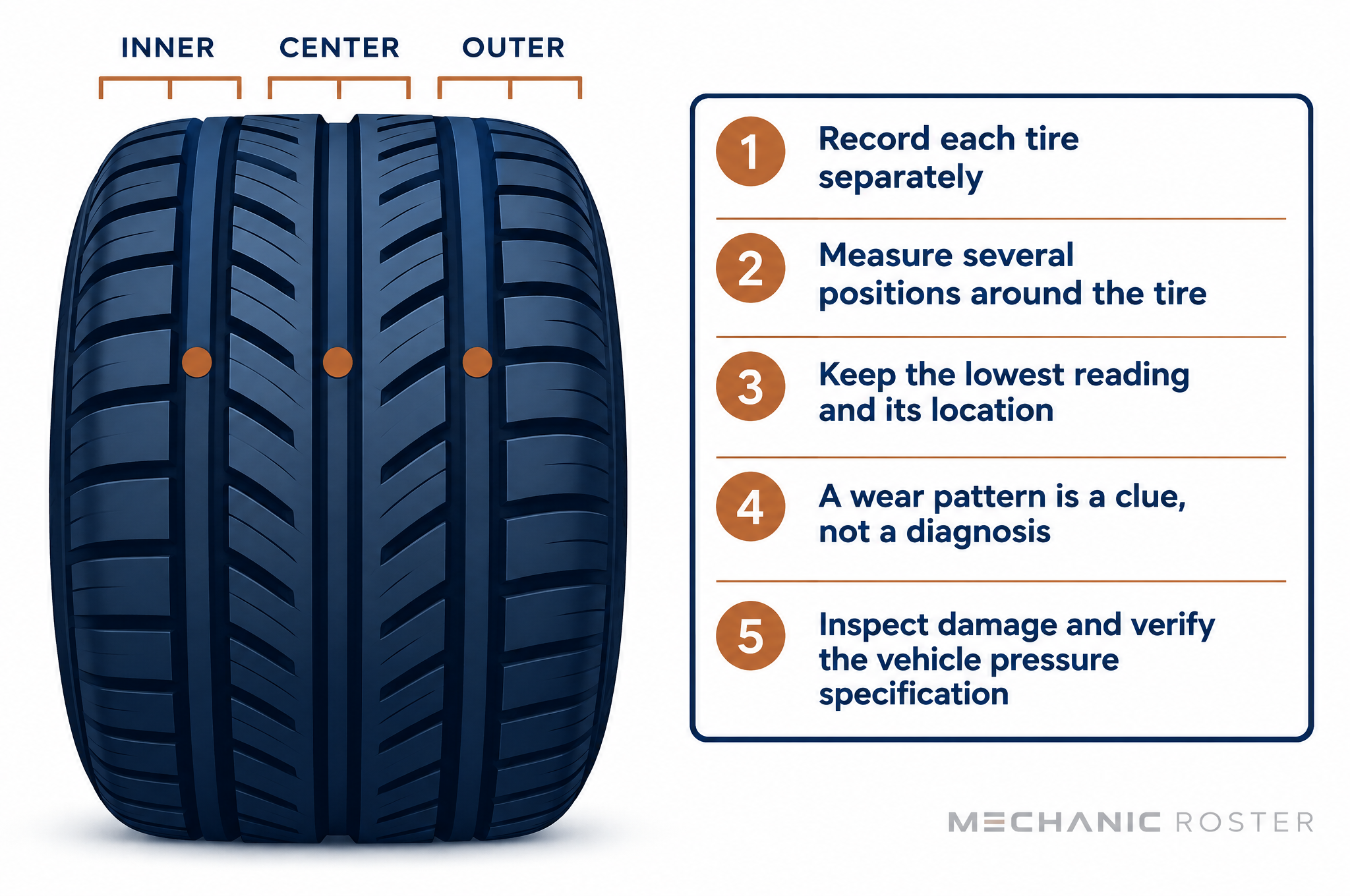
Preserve the location of every finding Inner and outer refer to the installed vehicle orientation, not a universal left/right side of this picture. Marked regions illustrate inspection coverage, not exact gauge-placement instructions. Use the vehicle-specific procedure for service.
Try it before reading the answer
Why is “all tires average 6/32 inch” insufficient if one shoulder measures 2/32 inch?
Worked answer and reasoning
The average hides the local low reading and its position. Record the individual values and evaluate the affected tire against applicable criteria, damage findings and cause investigation; the mean cannot substitute for the relevant minimum.
Measure pressure and tread meaningfullyRead & apply
Use the applicable vehicle placard and approved fitment guidance for recommended pressure. A tire sidewall maximum is not automatically that recommendation. Record whether the tire is cold or warm and follow the guidance for a valid comparison. Do not automatically bleed a warm tire down to a cold target simply because the measured pressure is higher.
Use a suitable gauge in good condition. A recurring loss after adjustment needs investigation; repeated inflation without finding the cause is not a completed repair. Inspect the valve, wheel, tire and relevant interfaces through the approved process. Document the measured condition and action, not only the final number.
Tread should be measured at defined locations across and around the tire as appropriate. Inner, center and outer readings can reveal patterns that one center reading hides. Uneven wear can involve pressure, alignment, looseness, damping or other conditions. The pattern directs investigation but does not uniquely identify a failed part.
Fictional tread worksheet, same unit at each point
Position
Inner
Center
Outer
LF
3
6
6
RF
6
6
6
The LF inner area is lower than its other measured areas. That is a documented pattern, not proof of one specific alignment angle or joint fault. Compare actual readings with applicable service and legal criteria for the jurisdiction and use.
Measure pressure in a defined state
Use the vehicle's applicable cold-pressure guidance for the approved fitment, not the sidewall maximum as a routine target. Record whether the tires meet the required temperature/use condition for that comparison. A warm pressure reading cannot be interpreted as though the tire had been cold without the appropriate guidance. Do not casually bleed a warm tire to a cold target and call the result complete.
Use a suitable gauge and record each position. If one tire repeatedly loses pressure after correction, the loss remains an unresolved finding. Pressure correction is not a leak diagnosis. Describe the amount and history, then follow the authorized inspection process. Compare the actual measurement with the reference and the conditions under which both apply.
Map tread instead of averaging away a problem
Measure at the required locations and document inner, center and outer areas where applicable. For a fictional tire, readings of 2, 6 and 6 mm do not describe a uniformly 4.7 mm tire. The low location and pattern matter. Units must stay consistent; do not compare millimeters with fractional inches without conversion. Wear patterns guide investigation but do not uniquely identify alignment, pressure or suspension causes.
Preserve the lowest reading and its location; an average can hide uneven wear.
Use the right pressure reference and units
Use the vehicle's applicable tire-pressure information and test conditions. The tire sidewall is not a substitute for the vehicle's recommended inflation reference. Record whether readings are cold or warm and avoid treating unlike conditions as a direct before-and-after comparison. TPMS does not replace routine pressure checks or physically add air to the tire.
For the fictional tread record below, keep the lowest measurement at each tire visible. The left-front inner measurement differs markedly from its center and outer values. The next action is not automatically “alignment only” or “sensor replacement.” Inspect the tire's condition, verify fitment and pressure information, and investigate appropriate mechanical and geometry factors.
Fictional tread worksheet—in 32nds of an inch
Position
Inner
Center
Outer
Left front
3
6
6
Right front
6
6
5
Left rear
7
7
7
Right rear
7
6
7
Try it before reading the answer
What is the lowest reading for each tire? Which recorded position most clearly needs investigation for uneven wear?
Worked answer and reasoning
The minima are LF 3/32, RF 5/32, LR 7/32 and RR 6/32 inch. The left front shows the largest inner-to-outer difference. This is evidence for inspection, not proof of a unique cause or a universal serviceability ruling.
Separate pressure correction from TPMS diagnosisRead & apply
TPMS is a warning system, not a replacement for regular tire maintenance. Some systems use sensors that report pressure; others infer a condition from wheel behavior. Identify the actual system before diagnosing, programming or relearning it. Do not assume every vehicle displays individual pressures or uses the same sensor process.
Read the owner's and service information to interpret the warning pattern. A low-pressure indication and a system malfunction indication can require different actions. Measure actual pressures and inspect condition rather than replacing a sensor solely because a lamp is on. Correcting pressure may not resolve a separate sensor, configuration or communication issue.
After tire or sensor work, confirm the required programming, ID learning, position learning or initialization for that application. Programming a compatible sensor and registering it to the vehicle are not necessarily the same step. Verify part compatibility, tool capability and the required procedure before declaring a new sensor defective.
Do not disable or conceal warnings as a substitute for repair. Record what was checked, what was corrected and what remains unresolved. A cleared display alone is not a complete test record.
TPMS and the tire condition are related but different
A tire-pressure monitoring system warns about conditions according to its design; it is not a substitute for a physical pressure and condition inspection. Identify whether the vehicle uses direct pressure-sensing devices, an indirect approach or another applicable arrangement. Required initialization, relearn and diagnostic procedures differ. Replacing a sensor is not a universal response to every warning.
Compare actual tire pressures, the observed warning behavior, available system information and relevant service history. A lamp that remains after pressure correction may require a defined drive/relearn process or diagnosis, depending on the vehicle. A lamp that turns off does not prove there is no leak or structural damage. Keep those conclusions separate.
Verify identity and completion
During authorized sensor-related service, follow the appropriate component, seal/hardware, programming and relearn requirements. Record the relevant result rather than merely noting that a tool was connected. Incorrect position association can mislead later diagnosis. Do not reset a system solely to hide a condition that has not been corrected or explained.
Distinguish pressure loss from monitoring faults
A low-pressure condition and a monitoring-system fault are distinct questions. Measure the physical pressure and inspect the tire as appropriate, then evaluate monitoring operation using vehicle information. Some systems use pressure sensors; others infer changes through other vehicle inputs. Do not assume every warning requires a replacement wheel sensor.
If pressure falls again after correction, investigate the physical loss. Clearing an indicator does not seal a leak. If pressure is correct but a malfunction indication remains, follow the system-specific diagnostic and relearn procedure rather than repeatedly adding air. Record the actual state of each concern so a customer is not told that pressure correction necessarily repaired the monitoring system.
Two related checks
Physical stateMeasure pressure and inspect condition
Loss sourceInvestigate recurring loss
System stateIdentify the monitoring arrangement
VerificationConfirm pressure and required system operation
Try it before reading the answer
The tire loses pressure overnight and a monitoring fault is also present. Does replacing a sensor alone resolve both concerns?
Worked answer and reasoning
Not without evidence. Identify and correct the physical loss through the appropriate process, and diagnose the monitoring fault separately. A sensor can be part of a leaking assembly in some cases, but that must be established rather than assumed.
Build the service plan from actual findings: tire repairability evaluation, replacement fitment, valve or sensor requirements, mounting/balancing, wheel procedures and any justified geometry investigation. Use the applicable vehicle and tire manufacturer requirements, including matching rules where relevant. Do not assume one replacement strategy is suitable for all drivetrains.
Complete required work through trained personnel using suitable equipment. Record final pressure and reference, wheel security procedure, orientation and TPMS status. Rotation patterns depend on the installed fitment and design; a staggered or directional setup may not follow a generic pattern. A torque value or relearn method from memory is not universal.
Verify that any originally reported leak or warning has been addressed using the appropriate method and conditions. If the warning persists or the leak has not been located, state that rather than reporting complete success. A new tire does not automatically repair a damaged wheel or a separate monitoring fault.
Explain routine pressure and condition checks, applicable rotation and maintenance guidance, and any actual follow-up requirement. Keep the customer's authorized choices and declined work in the record. This course certifies knowledge of inspection and TPMS fundamentals, not practical tire-machine competence.
Turn the inspection into a position-specific plan
List each tire's condition, relevant measurement, applicable reference and proposed action. If replacement is needed, confirm fitment and matching requirements for the actual application. If rotation is appropriate, use the permitted pattern for the vehicle and tire arrangement. A universal cross pattern can conflict with directional or staggered configurations.
For any suspected puncture, follow the tire manufacturer's permitted inspection and repair process with properly trained personnel. Do not treat the visible object size alone as permission to repair. The condition resulting from pressure loss and the complete inspection are part of the decision. Explain limits rather than promising that every flat can be patched.
Close the handoff
Verify the authorized work, pressure settings, wheel/fastener procedure and required monitoring-system completion. Record remaining damage or loss concerns and the next action. Give the customer appropriate maintenance information and explain warning behavior using the vehicle guidance. A neat printout is useful only when it accurately records what was inspected and completed.
Finish with recorded checks, not a cleared lamp
The service record should identify the performed work, fitment, pressure, required wheel-fastener procedure, monitoring relearn or initialization where applicable, and verification outcome. A cleared lamp alone is not proof of correct tire condition or system operation. Preserve any remaining diagnostic concern and explain what the customer should do if the warning returns.
A useful handoff includes pressure-check expectations and relevant maintenance information for the installed application. Avoid universal rotation advice when the fitment or vehicle procedure imposes restrictions. Explain alignment, balancing and tire-pressure correction as different services. Their effects can overlap in a customer's description, but each requires its own evidence and scope.
AssemblyComplete applicable wheel and system procedures
VerifyPressure, condition and monitoring result
ExplainMaintenance and any unresolved concern
Try it before reading the answer
After pressure correction, the lamp clears but the tire loses pressure again. What should the next record say?
Worked answer and reasoning
Record the recurring physical loss and investigate its source. The earlier lamp change was not proof the leak was repaired. Keep the pressure measurement, timing and monitoring behavior distinct.
Case conference: keep each tire's evidence separate
A fictional inspection records tread depths at inner, center and outer locations. The left-front tire also loses pressure between documented checks. The exercise does not provide a legal or service replacement threshold; use the applicable guidance on a real vehicle.
Case evidence — read before choosing an action
Position
Inner / center / outer
Lowest recorded value
Left front
3 / 5 / 5 mm
3 mm
Right front
5 / 5 / 5 mm
5 mm
Left rear
6 / 6 / 6 mm
6 mm
Right rear
6 / 6 / 6 mm
6 mm
Work through the decision
The average of the three left-front readings is not its minimum. Preserve position and measurement locations so a wear pattern remains visible. Additional circumferential checks and condition inspection may be needed under the applicable procedure. A low inner reading is a clue, not proof that toe or camber is the sole cause.
Investigate pressure loss separately from an electronic warning. A physical leak can exist with a functioning sensor, and a sensor/system fault can exist without a leak. Use the vehicle placard and specified cold-pressure guidance, not the sidewall maximum as a routine target. Record units and relevant conditions; do not compare an unexplained warm reading as if it were a matched cold reading.
After authorized correction, verify the physical condition and applicable TPMS operation. Sensor identification, relearn and initialization requirements depend on the vehicle and system type. Clearing a warning alone does not demonstrate that a leak has been repaired. Retain before-and-after pressure evidence and the verification conditions.
Your decision and evidence
What is the minimum recorded left-front tread depth? Explain why replacing its sensor is not yet justified by pressure loss alone.
Model answer and reasoning
The recorded minimum is 3 mm. Pressure loss requires an appropriate physical leak/condition investigation; it does not alone establish sensor failure. Record the warning behavior and system evidence separately, then follow the applicable TPMS procedure as needed.
Check your work
Keeps position and minimum visible
Separates leak diagnosis from TPMS diagnosis
Uses the correct pressure reference and conditions
Write your decision before revealing the model answer. These scenarios and numbers are fictional training examples.
The average hides the shoulder
A fictional tire has tread readings of 2, 6 and 6 mm at the named inner, center and outer locations. The worksheet reports only “4.7 mm average, satisfactory.” The vehicle also has a history of a pull. No applicable condition limit or further inspection is recorded.
Correct the record, identify what can and cannot be concluded, and propose the next evidence-based step.
Your evidence, decision and next step:
Compare with the model answer
Record all three locations and retain the 2 mm low reading and uneven pattern. The average conceals that condition. Compare each relevant finding with applicable requirements and inspect the tire as a whole. The pattern and pull justify further investigation but do not uniquely prove an alignment component fault. Confirm pressure, fitment and other relevant conditions before a repair recommendation. Do not invent a legal or manufacturer threshold absent from the supplied case.
A warning returns after pressure correction
A low tire is adjusted and the warning goes out after the prescribed process. Two days later the same tire is low again. The customer requests a new TPMS sensor because “the light keeps coming back.”
Explain why the request is not yet a diagnosis and write a plan separating physical tire pressure from monitoring-system function.
Your evidence, decision and next step:
Compare with the model answer
The repeated measured pressure loss is a physical finding that needs the appropriate leak/condition investigation. The warning may be responding to that actual condition; its recurrence does not by itself identify a failed sensor. Record measured pressure, time/history, position and warning behavior. Follow the authorized tire inspection and, if evidence supports it, the separate system diagnostic procedure. Verify the corrected condition and any required relearn rather than resetting the warning as the entire repair.
Apply it to a job
Complete a four-position tire inspection table with cold/warm status and inner/center/outer tread readings. Compare two fictional cases: an actual low tire and a TPMS malfunction with correct pressure. Write separate diagnostic plans. Create a delivery checklist that distinguishes pressure correction, leak verification, relearn and unresolved wear causes.
Your evidence and decision
Concern / scenario:
Observation, measurement and reference:
Interpretation and next action:
What remains unknown / who needs to review:
Verification and handoff:
Check your understanding
Explain each item in your own words. Revisit the relevant lesson if you cannot. This self-review is not a practical-skills sign-off.
Read fitment and service-description information by position.
Use the correct pressure reference and measurement conditions.
Preserve low tread readings instead of relying on averages.
Separate actual pressure loss from TPMS diagnosis.
Write an accurate service and verification handoff.
Practice before the assessment
Free, ungraded practice. Choose an answer, then check the explanation. These are separate from the final assessment bank.
Further study
Use current vehicle and equipment information for actual service. These public resources informed subject scope and support further learning; Mechanic Roster lessons and questions are original.