Read each lesson, work through its example, then answer the practice questions before revealing the explanations. Complete the written exercise before taking the assessment. Numerical examples are fictional training data, not vehicle service specifications.
Open study guideFree lessons for anyone. Print or save a PDF copy.
Plan for approximately 20 minutes of reading and 45 minutes working the examples and exercises. Assessment time is separate.
Camber and toe: choose the correct view
Caster is different: view the steering axis from the side. Under the usual sign convention, an upper steering-axis pivot rearward of the lower pivot is positive caster. Confirm the equipment convention.
These illustrations exaggerate angles for teaching. Never adjust from a sketch; confirm the vehicle-specific procedure and specification.
Course material
Study at your own pace. Open each lesson when you’re ready.
Prepare a vehicle that can be measured accuratelyRead & apply
Know the geometry and the parts that establish it
An alignment report describes relationships between wheels and reference directions. It does not directly identify a failed component.
Wheel and tire center plane
The reference used when describing angular orientation; tire condition and wheel condition still need inspection.
Camber
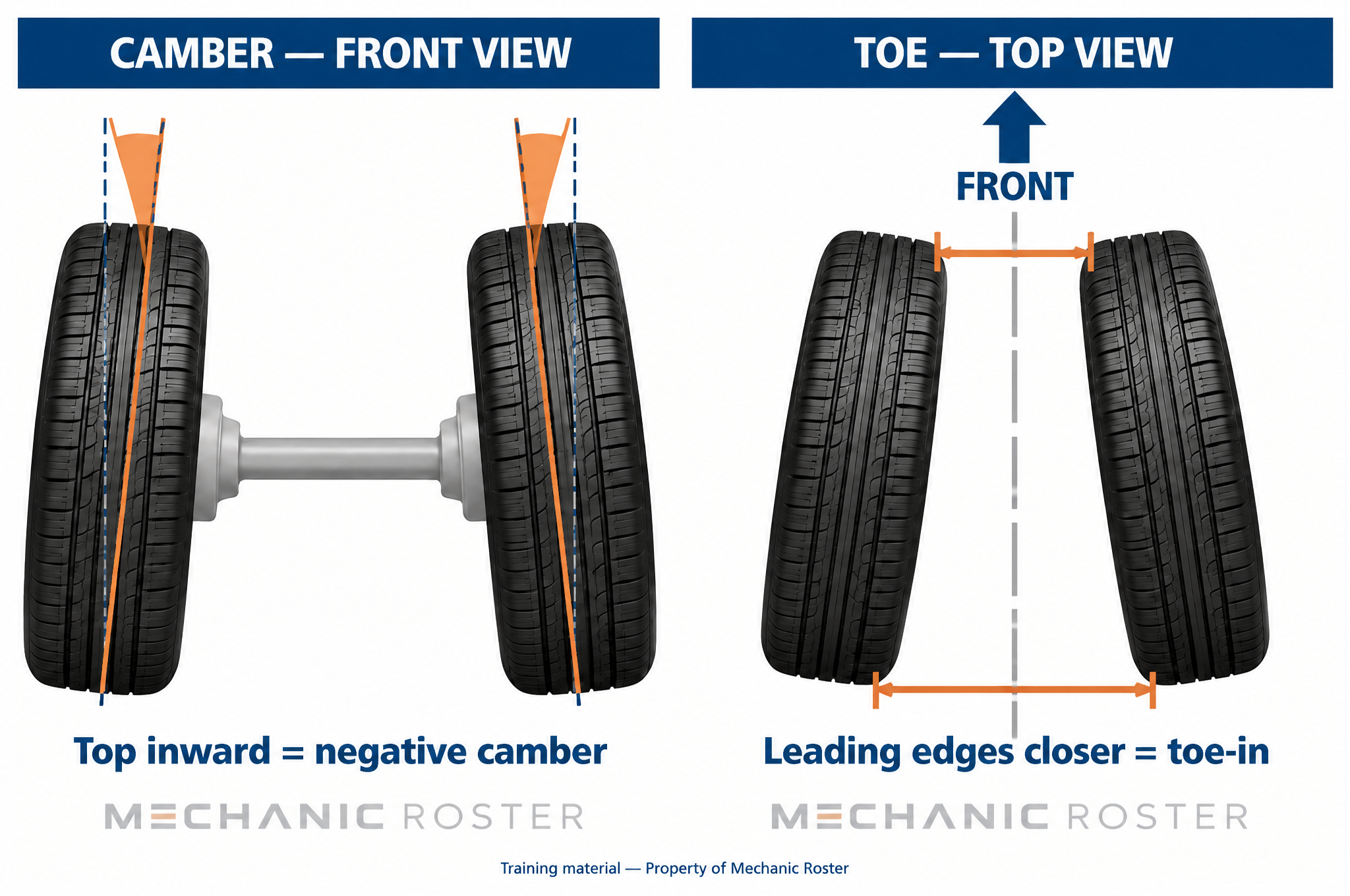
Wheel tilt relative to vertical in front/rear view. Top inward is negative camber.
Toe
Wheel direction in overhead view. Toe-in has leading edges closer together; confirm the equipment sign convention.
Caster
Steering-axis tilt in side view, not wheel camber. Positive caster places the upper steering-axis reference rearward relative to the lower.
Control arms, joints, links and strut/knuckle
Locate the wheel and steering axis; architecture varies. Adjustment provisions are vehicle-specific.
Rear thrust direction
The rear axle's directional relationship matters when interpreting steering-wheel position and the full alignment report.
How the parts work together
The vehicle structure and suspension locate the wheel; the alignment system measures its orientation under a defined setup. Ride height, loading, tire condition, worn components and measurement preparation can affect interpretation. Establish those conditions before adjusting angles.
Identify and explain
Which view distinguishes caster from camber, and why is a green total-toe value insufficient?
Check your explanation
Caster is a side-view steering-axis relationship; camber is front/rear-view wheel tilt. Total toe can be within its range while individual targets or steering-wheel position still need attention.
An alignment machine reports geometry; it cannot decide whether the vehicle was prepared correctly. Start with the VIN, suspension option, wheel and tire sizes, ride-height requirements, and current service information. Selecting a similar model can produce a convincing green screen against the wrong specification. Record the exact selection before measuring.
Check cold pressures against the applicable placard or approved fitment guidance. Inspect tires and wheels for damage, mismatched sizes, unusual wear and runout. Record loading, fuel level or ballast where the procedure specifies them. Measure ride height at the specified points: a body-panel gap is not automatically the correct reference. A sagged spring or extra cargo can change measured angles.
Inspect steering and suspension joints in their required loaded or unloaded state. Excess play prevents a repeatable adjustment; tightening an adjuster will not repair a loose joint. Check rack capacity and safe access, then follow the alignment equipment instructions for target attachment, compensation, turn plates and slip plates. Compensation accounts for mounting/runout effects; it is not wheel balancing.
Before you continue
Write down vehicle selection, tire pressures, load condition, ride height, inspection findings and compensation status. If any required condition is unknown, the readings are provisional—not a completed diagnosis.
Separate repeatability from accuracy
A machine can repeat the same number while comparing it with the wrong vehicle specification. That is repeatable but not a valid service decision. Conversely, correct specification data do not make unstable readings trustworthy. Check both the reference and the measurement conditions. Record suspension option, load state, tire condition, ride height and relevant equipment setup so a second technician can reconstruct the test.
Think of the vehicle, rack, targets and procedure as one measuring system. A target moved during the job, an unlocked mounting device, a plate that cannot move as required or a loose joint can undermine the result. When an unexplained change appears, return to the setup instead of chasing the reading with another adjustment. Document which condition changed and repeat the affected step under the equipment instructions.
Complaint interview
Ask whether the steering wheel is off-center when travelling straight, the vehicle drifts when the wheel is released under safe test conditions, or the driver feels a vibration. Those are not interchangeable complaints. Ask about recent impacts, tire changes and suspension work without assigning blame. Record road and load conditions. A customer saying “it needs an alignment” is requesting help with a concern; it does not establish that alignment is the only cause or cure.
Treat setup as part of the measurement
A convincing alignment report begins before the display turns green. Identify the vehicle and suspension configuration, confirm the applicable specifications, inspect the condition that could prevent repeatable measurement, and establish the required loading and ride-height conditions. Follow the equipment instructions for target mounting, compensation and plate operation. An incorrect setup can produce precise-looking numbers that are not valid for the job.
Imagine a customer installed cargo equipment and arrives with a full load. The correct response is not to assume unloaded specifications still apply or remove arbitrary weight until readings improve. Establish the vehicle's required measurement state and document how it was achieved. If a required condition cannot be met, explain the limitation and obtain direction before treating the printout as a final alignment result.
A trustworthy alignment baseline
IdentifyCorrect vehicle and suspension specification
InspectTires, mechanical condition and ride height
Set upLoading, targets and compensation
RecordInitial readings and measurement conditions
Try it before reading the answer
The report uses the correct model year but the wrong suspension option. Can the existing green bars be accepted?
Worked answer and reasoning
No. Select the applicable vehicle configuration, verify the required setup and reevaluate the measurements. The displayed pass/fail state is meaningful only relative to the right reference. Do not average specification ranges or select a broader option merely to obtain a pass.
Toe is the direction a wheel points when viewed from above. Toe-in means the front edges are closer together than the rear edges; toe-out means the opposite. Individual toe describes one wheel relative to the machine reference. Total toe is the signed sum for the axle. Verify whether the display uses decimal degrees, degrees and minutes, or a distance unit; they cannot be substituted without the proper conversion and wheel reference.
Camber is wheel tilt viewed from the front or rear. Top outward is positive; top inward is negative under the usual convention. Caster is steering-axis tilt viewed from the side, not wheel tilt. With the vehicle front identified, a steering axis whose upper point is rearward has positive caster. Some vehicles do not provide routine adjustment for every angle.
Thrust angle describes rear axle travel direction relative to the vehicle centerline. Front readings and steering-wheel position must be interpreted with rear geometry, not in isolation. A pull can also involve tires, road crown, brake drag, loading or damage. No one angle proves the cause of every complaint.
Use the diagram with the viewing direction stated aloud. Describing caster from a front-view wheel sketch is a common misunderstanding. These examples teach interpretation, not universal adjustment targets.
Choose the viewing direction first
Imagine looking down on two front wheels: you can compare where their leading edges point, which describes toe. Now stand conceptually in front of the vehicle: the wheel tops lean toward or away from the center, which describes camber. Finally, look from the side and identify the upper and lower steering-axis pivots: their fore-aft relationship describes caster. Caster is an axis angle, not the visible lean of a wheel in a front photograph.
Under the usual sign convention, positive caster places the upper pivot rearward relative to the lower pivot. Camber is positive when the wheel top leans outward. Equipment displays can define cross-angle subtraction differently, so write the formula before calculating. Individual toe values use a reference established by the machine and procedure. Do not substitute a centerline assumption for that reference.
Unit conversion exercise
Decimal degrees use a decimal fraction of one degree. Degrees and minutes divide a degree into 60 minutes. Convert 0°24′ by calculating 24÷60 = 0.40°. Convert 0.25° to minutes by calculating 0.25×60 = 15′. A display of 0.24° is not 0°24′. Distance-based toe additionally depends on a defined measuring diameter, so no single remembered distance-to-angle conversion works for every reference dimension.
Translate the picture into signed values
Toe describes wheel heading when viewed from above. Camber describes wheel tilt when viewed from the front. Caster describes steering-axis inclination in side view, not the tilt of the tire tread. Keep the view, reference direction and sign convention attached to the value. A diagram is a way to understand the quantity, not a substitute for vehicle specifications or the machine's procedure.
A total-toe calculation is signed addition. If left toe is +0.12° and right toe is −0.04°, total toe is +0.08°. Adding magnitudes would incorrectly produce +0.16°. Cross-angle calculations require a declared subtraction order: left minus right is the negative of right minus left. Angular minutes also differ from decimal hundredths: 0°24′ equals 24/60 = 0.40°, not 0.24°.
Keep the viewing direction attached to the angle Front view shows negative camber; top view shows toe-in with the front direction marked. Angles are exaggerated, not measurement targets. Caster is not shown. Use the vehicle-specific procedure for service.
Try it before reading the answer
Calculate total toe from +0.10° and −0.06°. Then convert 0°12′ to decimal degrees. Explain why those are different operations.
Worked answer and reasoning
Total toe is +0.04° by signed addition. Twelve angular minutes are 12/60=0.20°. The first combines two values already in the same unit; the second changes the representation of one angle. Neither operation uses tire pressure or an assumed universal linear-to-angular factor.
Interpret an alignment report before adjustingRead & apply
Save the initial readings before changing anything. Compare each value with the correct range, including individual toe, total toe, camber, caster, and rear thrust angle as applicable. A green total can hide an individual value outside its limit. Likewise, matching left and right values does not mean either is within specification.
Fictional training report — not service specifications
Measurement
Before
Allowed range
Interpretation
Left front camber
−0.4°
−0.8° to +0.2°
Within range
Right front camber
−1.2°
−0.8° to +0.2°
Outside range
Left front toe
+0.20°
+0.02° to +0.12°
Outside range
Right front toe
−0.02°
+0.02° to +0.12°
Outside range
Total front toe
+0.18°
+0.04° to +0.24°
Within range, but not the whole result
For this exercise, a total-toe-only judgment would miss both individual toe errors. The camber problem needs investigation of setup, ride height, component condition, subframe position and adjustment provisions. It does not justify declaring one particular part bent without evidence.
Define any cross-angle calculation before using it. If cross-camber is defined as left minus right, −0.4 − (−1.2) = +0.8°. Do not compare that signed result with a reference using the opposite convention. Cross-angle interpretation must account for the manufacturer's guidance and the complaint.
Decision exercise
List the out-of-range values, one setup condition to reconfirm, and one mechanical inspection to perform. Explain why adjusting the front toe to hide a rear thrust error is not a complete repair.
Read a report in layers
First confirm identity, units and setup. Then compare individual readings with their own ranges. Next consider axle totals and cross-angles using the stated conventions. Finally interpret the whole pattern with the complaint and mechanical findings. This order prevents a green total from distracting you from an out-of-range individual reading or an incorrect reference.
For a fictional axle, left toe is +0.18° and right toe −0.02°. Total toe is +0.16°. If each individual limit is +0.03° to +0.09° and the total limit is +0.06° to +0.18°, the total passes while both individuals fail. Moving the steering wheel to conceal an unequal split is not the same as establishing the required geometry and steering center under the procedure.
A camber result outside a nonadjustable range does not identify a bent strut by itself. Check whether the selection and setup are correct, whether ride height is correct and repeatable, and what component or mounting evidence exists. Tire wear is historical evidence: correcting today's reading does not erase wear already present or prove which past condition produced it. Explain that distinction when the customer expects old tires to become unworn after adjustment.
Read the complete report, not just the total
The fictional training report below intentionally contains an acceptable total with unacceptable individual values. The total of +0.20° and −0.04° is +0.16°, within the supplied total range. However, each wheel is outside its individual range. Calling that entire axle correct would hide the toe split and its implications for the steering reference. Reconcile individual and total requirements, then follow the specified adjustment procedure.
Similarly, left and right camber can match each other while both fail their absolute range. Symmetry does not establish compliance. When an angle is outside its reference, verify setup and investigate the mechanical cause before naming a failed part. Retain the initial readings and reference range so the customer and next technician can understand the decision.
Which toe values fail? Calculate cross-camber using left minus right. What cannot be concluded from this report alone?
Worked answer and reasoning
Both individual toe readings fail while total toe passes. Cross-camber is −0.3−(−0.9)=+0.6°. The report alone does not identify the cause, prove a component failure or establish whether a customer pull is resolved. Interpretation still requires the correct setup, applicable limits and vehicle procedure.
Adjust, verify and explain limitationsRead & apply
Follow the vehicle and equipment sequence rather than a memorized universal order. Where rear geometry is adjustable it often establishes the reference for subsequent front work, but the actual procedure controls. Identify the correct adjusters, allowable range and any one-time-use fasteners. Do not loosen unrelated structural fasteners or modify mounting holes without an approved repair procedure.
Center and hold the steering wheel as specified. Make controlled changes, settle the suspension when required, and remeasure after tightening. A value observed with loose fasteners is not the final result. Verify that the wheel remains centered and that toe, camber, caster and thrust readings meet the applicable requirements. Complete required steering-angle sensor resets or calibration steps; a mechanical adjustment does not itself perform an electronic calibration.
Before a road check, confirm secure fasteners, removed tools, safe tires, and no unresolved safety concern. Use the prescribed safe route and operating conditions. Record steering center, pull, noise and warning status. A persistent pull with acceptable angles needs further diagnosis; do not promise that every alignment cures vibration or tire wear.
Keep the vehicle identity, specification source, measurements, adjustments, torque/procedure reference, calibration results and road-check notes together. A report with an unresolved red value must explain the limitation rather than be presented as a fully successful alignment.
Close the loop on the original concern
The final screen is one part of verification. Save results with the fasteners secured and the vehicle settled under the applicable method. Confirm the required electronic resets or calibrations separately; a steering-angle value on a scan screen is not proof that a required calibration completed. Retain any procedure result and fault information needed to support the handoff.
Compare the original complaint with the final safe functional check. If the wheel is centered but the pull remains, one concern may be improved while another remains unresolved. Say so. Consider remaining tire, brake, road, loading or mechanical evidence through an authorized diagnostic plan rather than repeatedly adjusting acceptable angles to chase a symptom. Do not use a public road test when a safety defect makes vehicle movement inappropriate.
Explain the printout
Point to the before value, applicable range and after value. Use plain language: “This is the direction the front wheel points; we corrected it into this vehicle's specified range.” State any uncorrected angle, why it remains and the next recommended action. The report should identify the vehicle, date, technician, source selection and limitations. A page with green bars but no valid identity or setup record is weak evidence of a completed service.
Verify geometry and the customer's concern
Final readings should represent the secured, settled vehicle, with required recalibration or reset steps completed. An angle can move as a fastener is tightened or the suspension is settled; saving the earlier value does not document the final state. Evaluate all affected readings after the specified sequence rather than checking only the angle initially adjusted.
A road check and a measurement report answer related but different questions. A persistent pull with in-range angles may require investigation of tires, brake drag, road conditions or other causes. Conversely, a centered steering wheel does not make an out-of-range measured value acceptable. Explain precisely what was verified, which condition remains and what next step is authorized.
Close the alignment record
SecureComplete required fastener and settling steps
RemeasureSave final readings against correct references
VerifyDocument concern check and remaining limitations
Try it before reading the answer
The screen is green before tightening, but one reading is outside its limit afterward. Which value belongs in the final report?
Worked answer and reasoning
Use the final secured and remeasured state. Correct the condition through the prescribed procedure and recheck affected angles before claiming completion. An earlier green screen is not evidence of the delivered vehicle's geometry.
Case conference: total toe can hide unequal individual readings
A fictional front-axle report shows left toe +0.12 degrees and right toe -0.04 degrees. The exercise supplies a total-toe range of +0.04 to +0.12 degrees but no individual-toe limits. Positive denotes toe-in in this example. The steering wheel is reported off-center.
Case evidence — read before choosing an action
Quantity
Calculation
Interpretation
Left toe
+0.12 degrees
Individual reading
Right toe
-0.04 degrees
Individual reading
Total toe
+0.12 + (-0.04) = +0.08 degrees
Inside supplied total-only range
Angular conversion example
12 minutes / 60 = 0.20 degrees
Not 0.12 degrees
Work through the decision
Add signed readings; do not discard the minus sign. A total within range does not prove both individual readings or steering-wheel position are correct. Here the supplied information supports only the total-toe comparison. Retrieve the applicable individual targets and setup instructions before making an adjustment decision.
Camber is viewed from the front or rear relative to vertical; toe is viewed from above relative to the vehicle's reference direction. The illustration's view and front-direction label are essential. Do not use a perspective wheel picture to infer an exact angle. Caster requires its own side-view concept and measurement procedure; it cannot be read from the camber image.
Verify vehicle configuration, tire condition/pressure, required ride height/loading, equipment setup and compensation under the relevant instructions. Use the complete report, including rear-axle relationships, when interpreting an off-center steering wheel. After adjustment, follow any required steering-angle/calibration procedures and verify handling safely. A green total alone is not a complete handoff.
Your decision and evidence
State what the total proves, what remains unknown and why 12 angular minutes must not be entered as 0.12 degrees.
Model answer and reasoning
Total toe is +0.08 degrees and meets only the supplied total range. Individual targets, setup validity and the steering-wheel concern remain to be resolved. There are 60 angular minutes per degree, so 12 minutes equals 0.20 degrees. Record units and use the correct equipment display convention.
Check your work
Adds signed values correctly
Does not equate total pass with complete alignment
Write your decision before revealing the model answer. These scenarios and numbers are fictional training examples.
Total toe masks an unequal split
A fictional report shows left toe +0.17°, right toe −0.01°, left camber −0.3° and right camber −1.0°. Supplied limits are individual toe +0.02° to +0.10°, total toe +0.04° to +0.20°, and camber −0.7° to +0.1°. Cross-camber is defined here as left minus right. The vehicle's right ride height is also below the supplied reference.
Calculate total toe and cross-camber. Mark each individual angle in or out. Decide whether a front-toe adjustment alone can honestly be sold as resolving the whole condition. List three questions that must be answered before recommending a component.
Your evidence, decision and next step:
Compare with the model answer
Total toe is +0.16°, inside the supplied total range. Both individual toe readings are outside their ranges. Left camber is inside; right camber is outside. Cross-camber is −0.3−(−1.0) = +0.7° using the specified convention. No cross-camber pass/fail limit was supplied, so do not invent one.
A toe adjustment does not explain or correct the low corner and out-of-range camber by itself. Confirm the vehicle/configuration and load selection, repeat the ride-height and alignment setup correctly, and inspect the relevant suspension and mounting conditions. Ask what is actually adjustable under the vehicle procedure. The component recommendation must follow evidence; the report does not uniquely identify a spring, strut, arm or subframe fault.
A green report with an unresolved pull
The customer reports a consistent pull. After an authorized adjustment, the saved angles meet the applicable limits and the steering wheel is centered. During a safe prescribed check the pull remains. A teammate proposes making one angle deliberately incorrect until the driver no longer notices the pull. The tire inspection notes were incomplete.
Write the appropriate job status, the next diagnostic questions and a customer update. Explain why a successful adjustment and a resolved complaint are different claims.
Your evidence, decision and next step:
Compare with the model answer
The adjustment may be complete, but the complaint is not verified resolved. Preserve the valid report and document the remaining symptom. Recheck tire condition and fitment, relevant pressure and load conditions, possible brake drag, road influence and mechanical findings under the proper diagnostic procedure. Obtain approval for additional work where required.
Do not intentionally move an angle outside its specification to mask an unidentified cause. Tell the customer: “The measured alignment angles are now within specification, but the pull is still present under the documented check. We recommend the next diagnostic step to identify the remaining cause.” Avoid promising that another part or adjustment will solve it before evidence supports that conclusion.
Apply it to a job
Use the fictional report above. Calculate total toe and cross-camber (left minus right). Mark each individual value in or out of range. Write a setup checklist, a three-step investigation for the right camber, and a customer explanation. Then create a blank before/after table for a supervised job; leave specifications blank until you have the actual vehicle procedure.
Your evidence and decision
Concern / scenario:
Observation, measurement and reference:
Interpretation and next action:
What remains unknown / who needs to review:
Verification and handoff:
Check your understanding
Explain each item in your own words. Revisit the relevant lesson if you cannot. This self-review is not a practical-skills sign-off.
Identify toe, camber and caster by view without relying on a label.
Convert degrees/minutes and decimal degrees correctly.
Check individual angles even when total toe passes.
Separate repeatability, specification selection and mechanical condition.
Explain an unresolved concern without manipulating the report or promising an unproved repair.
Practice before the assessment
Free, ungraded practice. Choose an answer, then check the explanation. These are separate from the final assessment bank.
Further study
Use current vehicle and equipment information for actual service. These public resources informed subject scope and support further learning; Mechanic Roster lessons and questions are original.